Your website is usually the first thing a customer sees, and they see it on a phone. So we measured how local business websites hold up there.
On October 2, 2026 we took 300 independent small businesses from six chamber of commerce member directories, 150 in Scottsdale and 150 across Phoenix, Mesa, Tempe, Gilbert and Chandler, and ran each homepage through Google's PageSpeed Insights mobile test. We also read each homepage for the basics a local customer and Google both look for. No chains or franchises, and no business is named here.
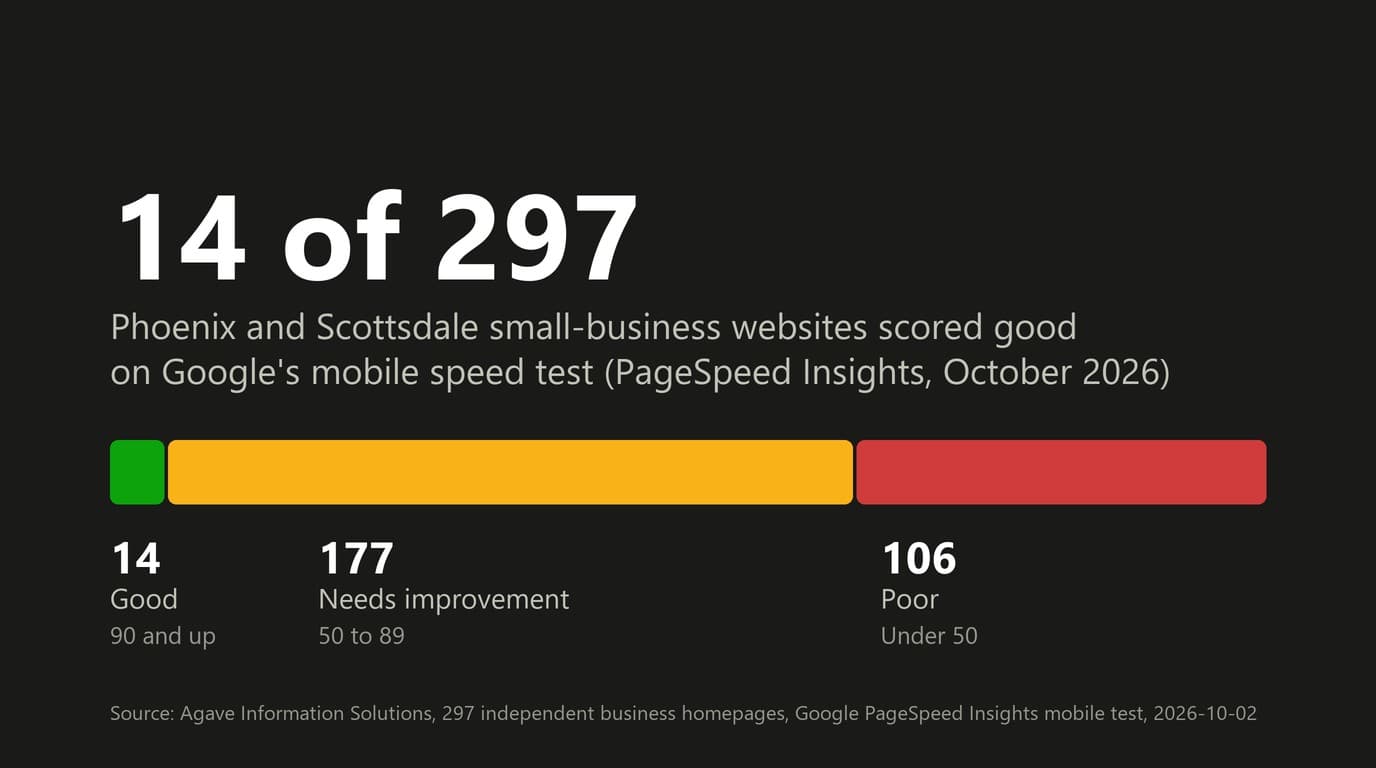
The Headline: 14 of 297 Scored Good
Google's test scores a page from 0 to 100 on a phone. 90 and up is good, 50 to 89 needs improvement, and under 50 is poor. Of the 297 sites the test could score:
- 14 scored good (5%).
- 177 needed improvement (60%).
- 106 scored poor (36%).
The median score was 56.
Scottsdale and the Phoenix side came out the same. Both had a median of 56, and both had exactly 53 sites in the poor band. A Scottsdale address does not buy a faster website.
The Wait Is the Problem
The number that matters most to a customer is how long until the main content appears. Google calls it Largest Contentful Paint and wants it under 2.5 seconds.
- 287 of 297 sites (97%) took longer than 2.5 seconds in Google's phone test.
- 261 (88%) took longer than 4 seconds, the point Google calls poor.
- The median was 9.7 seconds. 141 sites (47%) took longer than 10.
Google's test simulates a mid-range phone on a slower mobile connection, so it is harder than a new phone on good signal. That is on purpose: it is what a customer sees in a parking lot with two bars.
Real visitors tell a similar story where Google has data. Google collects real-visitor speed only for sites with enough traffic. Only 92 of the 300 (31%) had any. Of the 35 homepages with complete real-visitor data of their own, 21 passed Google's Core Web Vitals and 14 did not.
The Basics Are Missing, Too
Speed is not the only gap. On the homepage alone:
- 179 of 300 (60%) had no LocalBusiness structured data, the code that tells Google and AI assistants the business name, address, phone and hours in a form they read directly.
- 117 (39%) had no tap-to-call link. A customer on a phone has to copy the number by hand.
- 70 (23%) had no meta description, so Google writes the search snippet itself.
- 22 (7%) had no mobile viewport tag, so the page renders as a shrunken desktop page on a phone.
- 15 (5%) did not use HTTPS, and browsers mark them "Not secure".
- 29 of the 194 sites that show a copyright year show 2024 or earlier.
Which Platforms We Found
The page code names the platform on most sites. WordPress ran 143 (48%), Wix 21, Squarespace 19, GoDaddy's builder 12, Shopify 8 and Duda 5; 81 could not be identified. Median phone scores by platform: Duda 64 (5 sites), Wix 63, WordPress 56, GoDaddy 45.5, Squarespace 42, Shopify 39.5. The smaller groups are small, so read those as a direction, not a ranking. What decides the score is how a site is built and what it loads, more than which builder it sits on.
What to Fix First
If you own one of these sites, in order:
- Run the test yourself. Google's PageSpeed Insights is free. Use the Mobile tab, and run it twice, because single runs vary.
- Shrink what loads first. On most slow sites the biggest cost is a large hero image or video, plus scripts for sliders, chat widgets and trackers. Compress the image, size it for a phone and load the rest later.
- Add tap-to-call. A phone link is one line of code and the most useful button a local site has.
- Add LocalBusiness structured data with your name, address, phone, hours and service area, matching your Google Business Profile exactly.
- Write a meta description for the homepage and each service page, in the words a customer would search.
If you would rather have someone look, our free website check reviews your site's speed and local search basics and tells you what to fix first. We build fast local websites for businesses in Phoenix and Scottsdale.
How We Did It
- Sample: 300 independent small businesses with their own website, taken from the member directories of the Scottsdale, Mesa, Greater Phoenix, Tempe, Chandler and Gilbert chambers of commerce: 150 in Scottsdale and 150 on the Phoenix side (Mesa 58, Phoenix 47, Tempe 32, Gilbert 7, Chandler 6). Trades as each directory lists them, led by health care, restaurants, retail, real estate, personal services, legal, contractors and professional services. Chains and franchises, businesses with no website or only a social or directory page, and sites that failed to load twice were left out.
- Speed: Google PageSpeed Insights API, mobile strategy, performance category, one run per homepage, on 2026-10-02 between 12:29 and 13:20 UTC. Three sites returned no score and are left out of the speed figures.
- Real-visitor data: Google's Chrome UX Report as returned by the same API, counted only at the page's own level (not site-wide), and never filled in from the lab test.
- Basics: one plain fetch of each homepage, reading the HTML as served. A feature added later by scripts, or present only on an inner page, counts as absent.
- Platform: the generator tag or the platform's own asset paths only.
Agave Information Solutions builds custom software, local-first websites, SEO, and private AI search solutions for organizations that want to be found. Based in Scottsdale, serving all of Arizona.