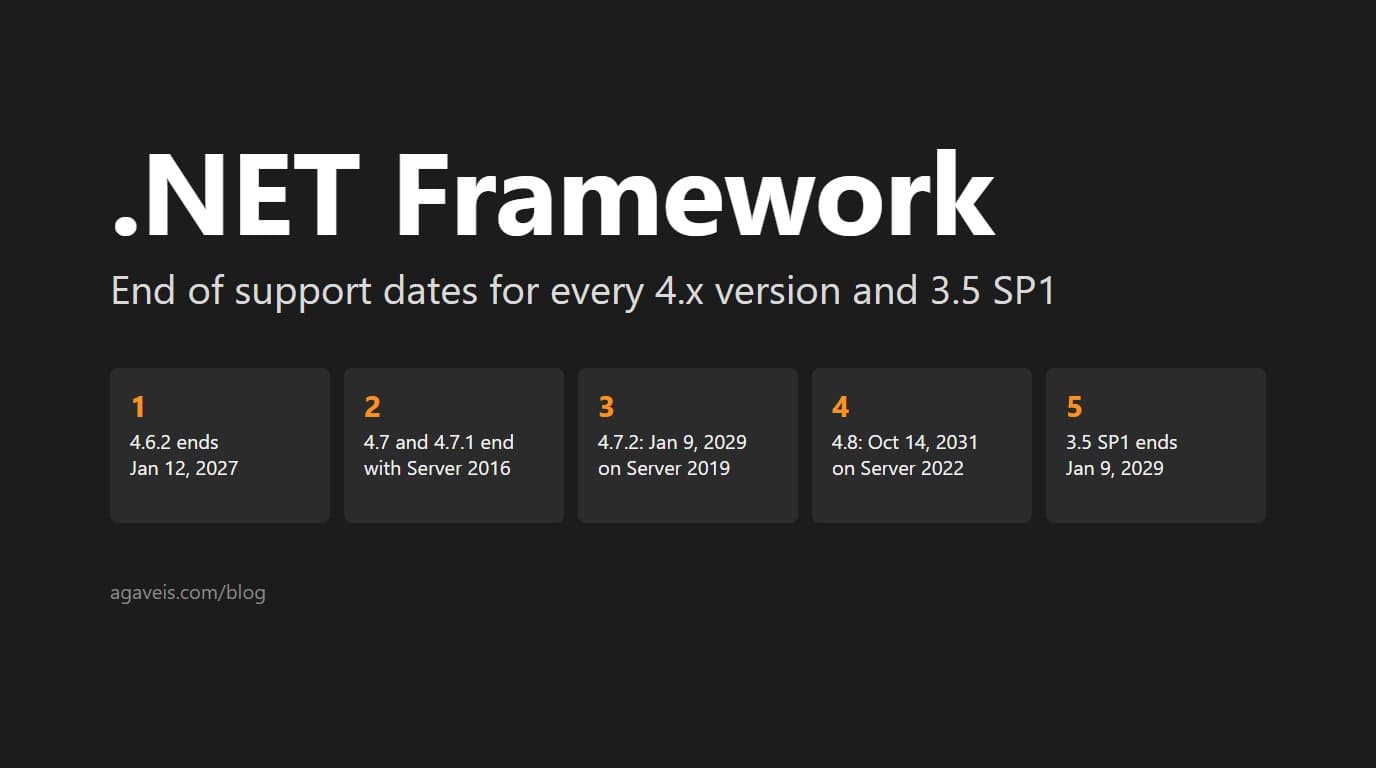
Seven versions of .NET Framework are still supported. Only two have an end date of their own: 4.6.2 ends on January 12, 2027, and 3.5 SP1 ends on January 9, 2029. The other five, 4.7 through 4.8.1, are supported for as long as the Windows version they are installed on, so the server sets the date. The table below lists every 4.x version and 3.5 SP1 with its release date, its end of support, and the date that applies on a server.
Every Version in One Table
Release dates and end dates come from Microsoft's .NET Framework support policy. The newest Windows Server each version is supported on comes from Microsoft's lifecycle FAQ for .NET Framework, and the server dates from its Windows Server release information.
| Version | Released | End of support | Date that applies on a server |
|---|---|---|---|
| 4.8.1 | August 9, 2022 | None of its own | November 14, 2034 on Windows Server 2025, the newest today |
| 4.8 | April 18, 2019 | None of its own | October 14, 2031 on Windows Server 2022 |
| 4.7.2 | April 30, 2018 | None of its own | January 9, 2029 on Windows Server 2019 |
| 4.7.1 | October 17, 2017 | None of its own | January 12, 2027 on Windows Server 2016 |
| 4.7 | April 5, 2017 | None of its own | January 12, 2027 on Windows Server 2016 |
| 4.6.2 | August 2, 2016 | January 12, 2027 | January 12, 2027 |
| 4.6.1 | November 30, 2015 | Ended April 26, 2022 | Out of support |
| 4.6 | July 20, 2015 | Ended April 26, 2022 | Out of support |
| 4.5.2 | May 5, 2014 | Ended April 26, 2022 | Out of support |
| 4.5.1 | October 17, 2013 | Ended January 12, 2016 | Out of support |
| 4.5 | August 15, 2012 | Ended January 12, 2016 | Out of support |
| 4.0 | April 12, 2010 | Ended January 12, 2016 | Out of support |
| 3.5 SP1 | November 18, 2008 | January 9, 2029 | January 9, 2029 on Windows Server 2019 and later |
The last column is the latest date each version can reach: the end of extended support for the newest Windows Server it is supported on. On an older server the date is that server's. A 4.8 application on Windows Server 2016 ends with the server on January 12, 2027, while the same application on Windows Server 2022 is supported until October 14, 2031.
The Next Date: January 12, 2027
Two things end that day. .NET Framework 4.6.2 reaches its own end of support on every operating system. Windows Server 2016 reaches the end of extended support, and every .NET Framework version installed on it goes with it. Versions 4.7 and 4.7.1 are supported on nothing newer, so an application still running on one of them needs a newer server and the newer runtime that comes with it.
Microsoft sells more time for the server. Extended Security Updates for Windows Server 2016 run in three paid yearly steps, ending January 11, 2028, January 9, 2029 and January 8, 2030, and cover Critical and Important security updates. Microsoft calls the program "a last resort paid option" and "a temporary bridge," and says it "does not extend the product's lifecycle." It is a way to pay for the months a migration takes.
Why 4.7 Through 4.8.1 Have No Date
Microsoft's policy explains the blank cells: "Beginning with version 4.5.2 and later, .NET Framework is defined as a component of the Windows operating system (OS). Components receive the same support as their parent products." The version follows the lifecycle of the Windows it is installed on.
Version 4.8.1 is the latest, and Microsoft says it "will continue to be distributed with future releases of Windows. As long as it is installed on a supported version of Windows, .NET Framework 4.8.1 will continue to also be supported." Our post on whether .NET Framework 4.8 is end of life covers what that support includes and how to check the version a server runs.
Three versions ended early for a different reason. Microsoft retired 4.5.2, 4.6 and 4.6.1 on April 26, 2022 because those releases were signed with SHA-1 certificates.
3.5 SP1 Is the Exception
.NET Framework 3.5 SP1 is the one old version with years left, and the one with a fixed date. Beginning with Windows 10 version 1809 and Windows Server 2019, Microsoft treats it as a standalone product with "5 years of mainstream support followed by 5 years of extended support." That support ends January 9, 2029, and Microsoft's FAQ says "Future Windows releases will not affect the lifecycle of .NET 3.5 SP1." A newer server does not move the date.
On older systems 3.5 SP1 is still a component, so on Windows Server 2016 it ends with the server on January 12, 2027. Versions 2.0 and 3.0 ended as products on July 12, 2011, according to Microsoft's lifecycle page. Their components stay supported as part of 3.5 SP1 for as long as 3.5 SP1 is.
The Version You Target Is Not Always the Version You Run
Find your row by the runtime installed on the server, not the version in the project file. Microsoft describes 4.6.2 and later as "compatible, in-place updates on top of .NET Framework 4, 4.5, 4.5.1, 4.5.2, 4.6 and 4.6.1," and adds: "Recompiling of apps to target these versions is not necessary." An application built for 4.5 ten years ago may be running on 4.8 today because the server was updated around it. The 4.8 post has the one-line registry check.
What to Do, by Version
- 4.0 through 4.6.1: out of support today. Update the runtime in place. Microsoft's advice: "We recommend customers upgrade to .NET Framework 4.8 to receive the highest level of performance, reliability, and security." It also recommends validating the update in a pre-production environment first.
- 4.6.2: the same in-place update, done before January 12, 2027.
- 4.7 and 4.7.1: the server is the deadline. Move the application to a newer Windows Server, where it runs on 4.7.2 or later without a recompile.
- 4.7.2: supported on Windows Server 2019 until January 9, 2029. An update to 4.8 on Windows Server 2022 reaches October 14, 2031.
- 4.8 and 4.8.1: nothing to do about the runtime. Watch the server date.
- 3.5 SP1: January 9, 2029 is fixed, and there is no newer 3.x. Leaving it means changing code: a retarget to 4.8, or a migration to .NET.
Stay or Move
A newer server buys years for the application as it is. A migration buys a platform that is still being developed. If the plan is to move, the target is .NET 10, the current long-term support release, which Microsoft supports until November 14, 2028. The .NET modernization page sets out the path in order, from the project system and data access through identity and deployment. AgaveIS takes on these migrations at a fixed scope and a fixed fee, priced after reading the code.