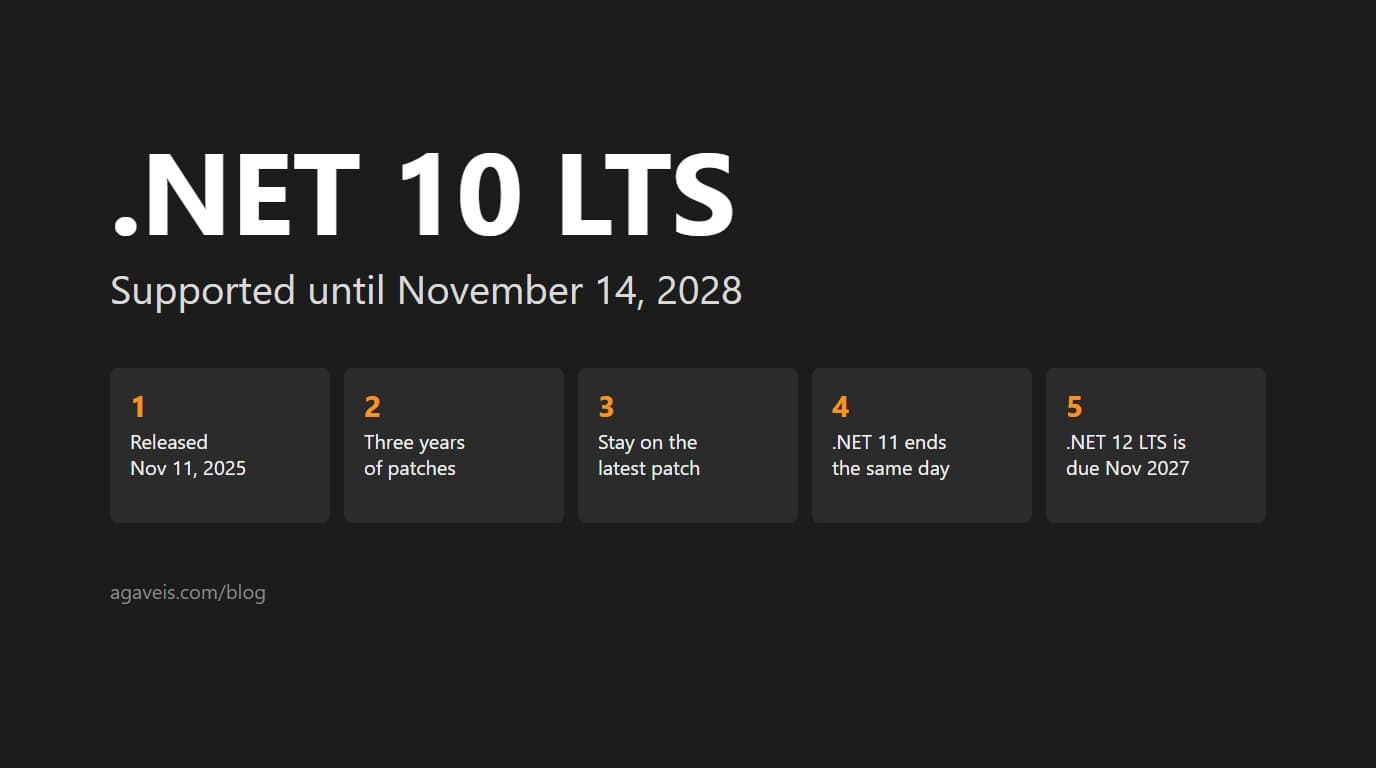
.NET 10 is a long-term support (LTS) release. Microsoft released it on November 11, 2025 and supports it until November 14, 2028. The latest patch is 10.0.15, released November 10, 2026. Below is every date in the .NET 10 lifecycle, what LTS covers, how .NET 11 compares, and when the next move comes due.
The .NET 10 Support Dates, From Microsoft
These dates come from Microsoft's .NET and .NET Core support policy, last updated November 10, 2026. Microsoft's release index carries the same end date.
- Released: November 11, 2025.
- Release type: LTS, with three years of free support and patches.
- Latest patch: 10.0.15, released November 10, 2026. The matching SDK is 10.0.404.
- Support phase today: active.
- Maintenance support: the final six months, which begin in May 2028. In that phase Microsoft ships security fixes only.
- End of support: November 14, 2028.
Why the End Date Is November 14 and Not November 11
Three years after the release date would be November 11, 2028, a Saturday. Microsoft does not end support on the anniversary. Its policy says end-of-life dates "align with Microsoft Patch Tuesday (second Tuesday of each month)," and the second Tuesday of November 2028 is the 14th. The same rule moved .NET 6 from November 8 to November 12, 2024.
Patch Tuesday also sets the rhythm in between. When Microsoft ships a .NET update, it ships on the second Tuesday of the month, and each update is cumulative: it contains every fix before it.
What LTS Means for .NET 10
LTS is about time, not quality. The policy puts it this way: "The quality of all releases is the same. The only difference is the length of support." LTS releases get three years. Standard-term support (STS) releases get two. Microsoft publishes a new major version every November, and the even-numbered ones are LTS.
The support covers more than the runtime. The policy names "the runtime, the SDK, ASP.NET Core, and Entity Framework Core," so ASP.NET Core 10 and EF Core 10 share the November 14, 2028 date.
LTS does not mean install once and leave it for three years. The policy is direct about that: "Customers choosing LTS need the latest patch update installed to qualify for support." A server still running 10.0.3 does not qualify until it is patched. How the patch arrives depends on how the app was published. On Windows, Microsoft Update can patch the shared runtime that framework-dependent apps use. A self-contained app carries its own copy of the runtime, and the policy says such apps "are still responsible for keeping the runtime updated," which means publishing the app again.
Check Which Patch You Run
Support depends on the patch, so check it. On the server, this lists every installed runtime with its full version:
dotnet --list-runtimesLook for the Microsoft.NETCore.App and Microsoft.AspNetCore.App lines that start with 10.0. If the highest is below 10.0.15, the machine is behind. For a self-contained app the installed runtimes do not matter. The version that counts is the one the app was published with, and the SDK that built it decides that. Check the global.json file, then the build machine:
dotnet --list-sdks.NET 10 or .NET 11: Both End the Same Day
.NET 11 arrived on November 10, 2026. It is an odd-numbered release, so it is STS with two years of support, and Microsoft lists its end of support as November 14, 2028. That is the same day as .NET 10.
| Version | Type | Released | End of support |
|---|---|---|---|
| .NET 8 | LTS | November 14, 2023 | Ended November 10, 2026 |
| .NET 9 | STS | November 12, 2024 | Ended November 10, 2026 |
| .NET 10 | LTS | November 11, 2025 | November 14, 2028 |
| .NET 11 | STS | November 10, 2026 | November 14, 2028 |
Moving a production service from 10 to 11 buys new features and no extra support time. A service on .NET 10 today has nothing to gain from 11 on the calendar.
When the Next Move Comes Due
By Microsoft's cadence the next LTS release is .NET 12, due in November 2027. Microsoft has not published its dates yet. On that cadence .NET 12 arrives a full year before .NET 10 leaves support, and that year is the upgrade window: November 2027 to November 14, 2028.
That makes LTS to LTS the quiet path. A team on .NET 10 upgrades once, to .NET 12, with twelve months to do it. A team that takes every release upgrades every year.
Still on .NET 8 or .NET 9?
Both reached end of support on November 10, 2026, and neither gets another fix. The target is .NET 10. Our post on .NET 8 and .NET 9 reaching end of support lists the six places that upgrade touches, from the target framework and the packages to the SDK pins and the container images.
Still on .NET Framework?
.NET Framework runs on a different clock. Versions 4.8 and 4.8.1 have no end date of their own and stay supported for as long as the Windows version under them. The post on whether .NET Framework 4.8 is end of life has those dates. A migration that starts now should land on .NET 10: no release has a later end date, and .NET 10 has a year of patches behind it.
Choosing the Target Is the First Decision
Every upgrade and every migration starts by naming the version it lands on. For a production system in late 2026 that is .NET 10: the current LTS release, supported until November 14, 2028. Write down each service, the version it targets today and how it is published, and the size of the job fits on one page.
We take on this work at a fixed scope and a fixed fee, priced after reading the code. Our .NET modernization page covers how the work is scoped.